
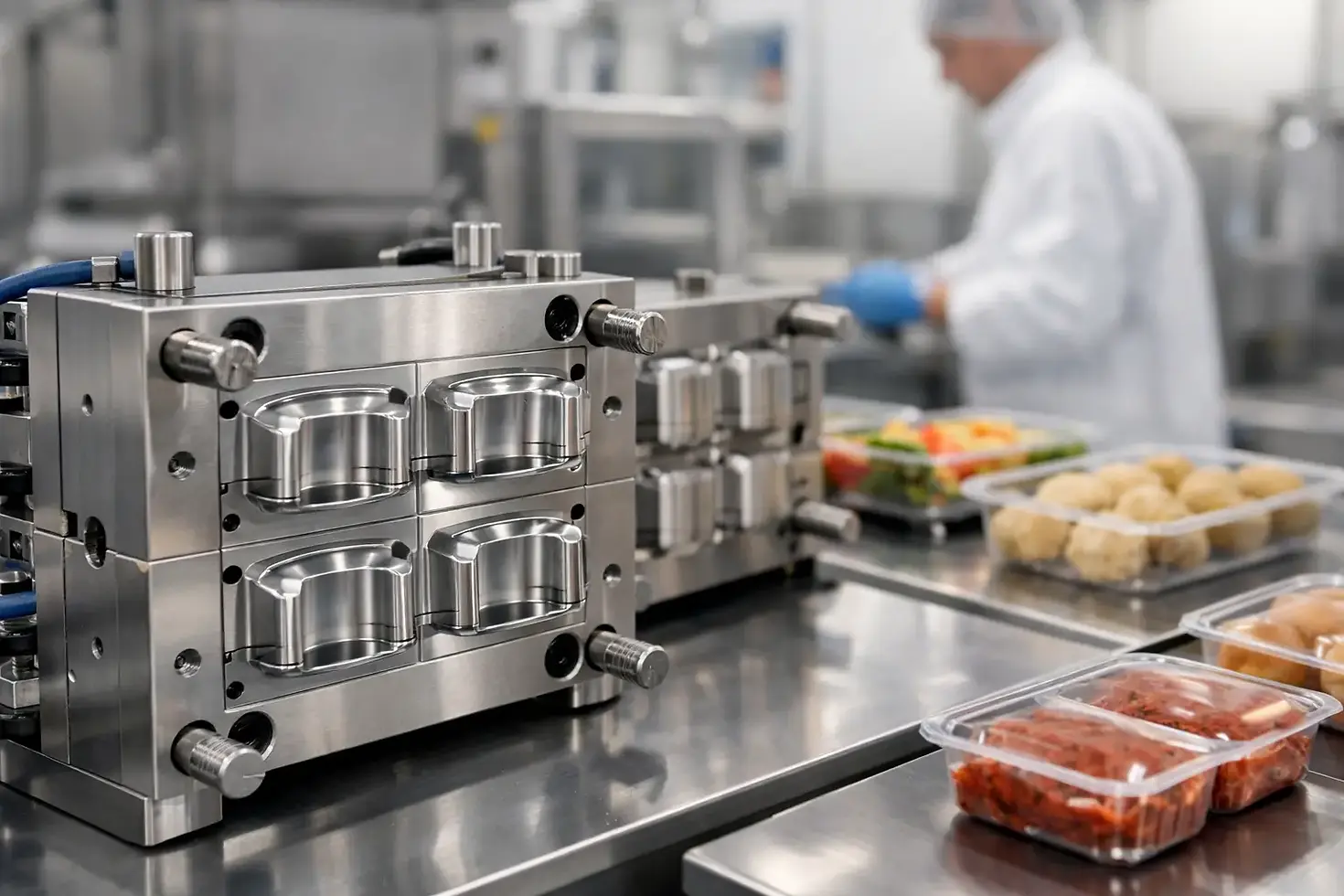
Hygienic Moulds for Food Processing That Work
A mould that releases cleanly but traps residue around its rim is not a production solution. It is a cleaning burden waiting to create downtime, inconsistency and avoidable risk. Hygienic moulds for food processing must do more than create an attractive finished product. They need to support reliable cleaning, controlled handling and repeatable output at the pace your operation requires.
For bakeries, confectioners, ready-meal producers and food manufacturers, mould design is often treated as a purchasing detail. In practice, it affects product yield, labour requirements, line flow and the confidence your team has in every batch. The right mould system is designed around the product, the process and the hygiene standards your site must maintain.
Why hygiene starts with mould design
Food hygiene is not addressed by material selection alone. Food-safe silicone is a highly capable option for commercial production, but the geometry of the mould matters just as much. Deep undercuts, sharp internal corners, awkward cavities and poorly considered edges can make cleaning more difficult, even when the material itself performs well.
A hygienic mould should have a surface and shape that allow operators to clean and inspect it efficiently. Smooth transitions, accessible cavities and an appropriate level of detail all reduce the likelihood of food debris remaining after washing. This is particularly relevant for products with sticky, fatty, aerated or particulate-heavy mixes, where residue can collect in places that are difficult to see during a busy shift.
The commercial impact is clear. If a mould is difficult to clean, cleaning takes longer. If cleaning takes longer, changeovers slow down and labour costs rise. If cleaning is inconsistent, the risk to product quality and compliance increases. Hygiene-led design protects the process before the mould reaches the production floor.
What hygienic moulds for food processing need to deliver
The best solution depends on the food product and operating environment, but commercial moulds commonly need to balance five requirements: safe food contact, reliable release, efficient cleaning, dimensional consistency and long service life.
Silicone is well suited to this balance when it is correctly specified and manufactured. Its naturally non-stick properties can reduce the need for release agents in many applications, helping producers achieve cleaner product surfaces and reduce waste caused by tearing or sticking. It also performs across a wide temperature range, making it suitable for processes involving freezing, baking, chilling and heated preparation.
However, non-stick performance should not be confused with a guarantee that every product will release in every condition. Product formulation, sugar or fat content, bake profile, cooling time and fill weight all affect demoulding. A high-detail chocolate piece, for example, creates different release demands from a frozen dessert portion or a plant-based ready-meal component. A capable mould manufacturer tests those variables through the design process rather than treating the cavity shape as an isolated decision.
Durability matters too. Commercial teams need moulds that retain their shape and release performance over repeated cycles. A low-cost mould that deforms, tears or begins to retain residue prematurely can quickly cost more through replacement, lower yield and production disruption. The most useful measure is not the unit price. It is the cost of dependable output over the working life of the mould.
Custom geometry reduces risk and waste
Standard moulds can be suitable for straightforward products and smaller runs. But they often require producers to adapt the product or workflow to fit an off-the-shelf format. That compromise can show up as awkward filling, uneven portioning, difficult handling or unnecessary trimming after demoulding.
A bespoke mould allows the cavity, overall tray format and handling features to be engineered around the actual line. That may mean adapting the mould footprint to existing racks or depositing equipment, adjusting cavity depth to achieve a target portion weight, or adding structural support so the mould remains stable during transport between stations.
For products that require precise visual presentation, bespoke moulding also protects consistency. The same applies where portion control supports margin management, nutritional declarations or retail specification. Small dimensional variations across thousands of units can become a significant issue, particularly where product weight is closely controlled.
Thoughtful design also avoids the false choice between visual detail and cleanability. Some intricate designs are achievable, but every additional texture, fine line or narrow recess should have a purpose. Where a detail compromises release or makes inspection unnecessarily difficult, simplifying it can produce a better commercial result.
Design for the full production workflow
A hygienic mould is only effective if it works from filling through to washing and storage. This requires an understanding of how your team uses it in real conditions, not just how it looks on a drawing.
Consider a bakery producing filled cakes at volume. The mould may need enough rigidity to pass through depositing, baking, cooling and packing stages without flexing excessively. Yet it must still have the flexibility required for clean release. A confectionery producer may instead need highly accurate cavity detail, stable tempering behaviour and a layout that supports efficient handling at each stage.
In ready meals, dairy and frozen applications, the priority may be different again. Thermal cycling, handling when cold, stacking arrangements and speed of turnaround can all influence the appropriate design. There is no universal cavity depth, wall thickness or silicone hardness that suits every line.
Before manufacturing begins, a useful project brief should define:
the food product, recipe characteristics and target finished weight;
process temperatures, dwell times and expected cycle frequency;
filling, baking, chilling, freezing and demoulding methods;
cleaning procedures, inspection requirements and storage conditions; and
equipment interfaces, handling constraints and expected production volumes.
These details allow a manufacturer to identify potential problems early, when they are inexpensive to address. For example, a change to the tray perimeter or a small adjustment to cavity draft can prevent repetitive handling difficulties once production has started.
Material compliance and traceability are practical safeguards
Food producers need confidence that mould materials are appropriate for their intended use and can be supported with the relevant documentation. This is especially significant where products are supplied to major retailers, exported, produced for vulnerable consumers or manufactured under tightly controlled quality systems.
A professional mould partner should be able to discuss material suitability, temperature exposure and the intended application clearly. The conversation should also cover traceability, manufacturing control and whether the final mould design supports your own hygiene and validation procedures.
For many businesses, confidentiality is equally important. New product shapes, signature decorations and process improvements can form part of a competitive advantage. NDA-backed development gives R&D and operations teams room to share the information needed to engineer the right solution without exposing commercially sensitive concepts.
Cleaning performance should be validated, not assumed
Cleaning instructions are only as useful as the mould’s ability to withstand the intended process. Detergent type, wash temperature, mechanical action and drying conditions can all affect service life. Silicone is durable, but it is not a reason to overlook the practical effects of aggressive cleaning regimes or unsuitable handling.
The right approach is to match the mould specification to your cleaning method and then establish a clear routine for inspection. Teams should be able to identify damage, residue build-up or loss of performance before it affects product quality. This is easier when the mould has been designed with accessible forms and a sensible level of detail from the outset.
It is also worth considering how moulds are moved and stored. Overcrowded storage, sharp implements and rushed handling can damage even well-made moulds. A mould system designed with stackability, support trays or handling features can reduce that exposure while improving workflow.
Choosing a mould partner for long-term production
A supplier can provide a mould. A manufacturing partner helps solve the production problem behind it. That distinction becomes more valuable as volumes grow, product complexity increases or a line needs to meet tighter consistency targets.
At TCI Culinary, bespoke mould projects are developed in-house in the UK, from concept and design through to manufacture and workflow integration. This gives producers a direct route to technical collaboration, controlled quality and accountable support throughout the project. Warranty protection and dedicated account management further help teams plan with confidence rather than treating mould performance as an unknown variable.
The strongest mould projects begin with an honest review of the current process: where product sticks, where cleaning takes too long, where operators compensate for inconsistent tools, and where waste is eroding margin. Addressing those points in the mould design can turn a routine consumable into a more reliable part of your production system.
When hygiene, release and repeatability are designed together, the mould becomes easier for operators to trust. That confidence creates room for the work that matters most: producing consistent food, protecting standards and growing output without adding unnecessary friction.


Comments