
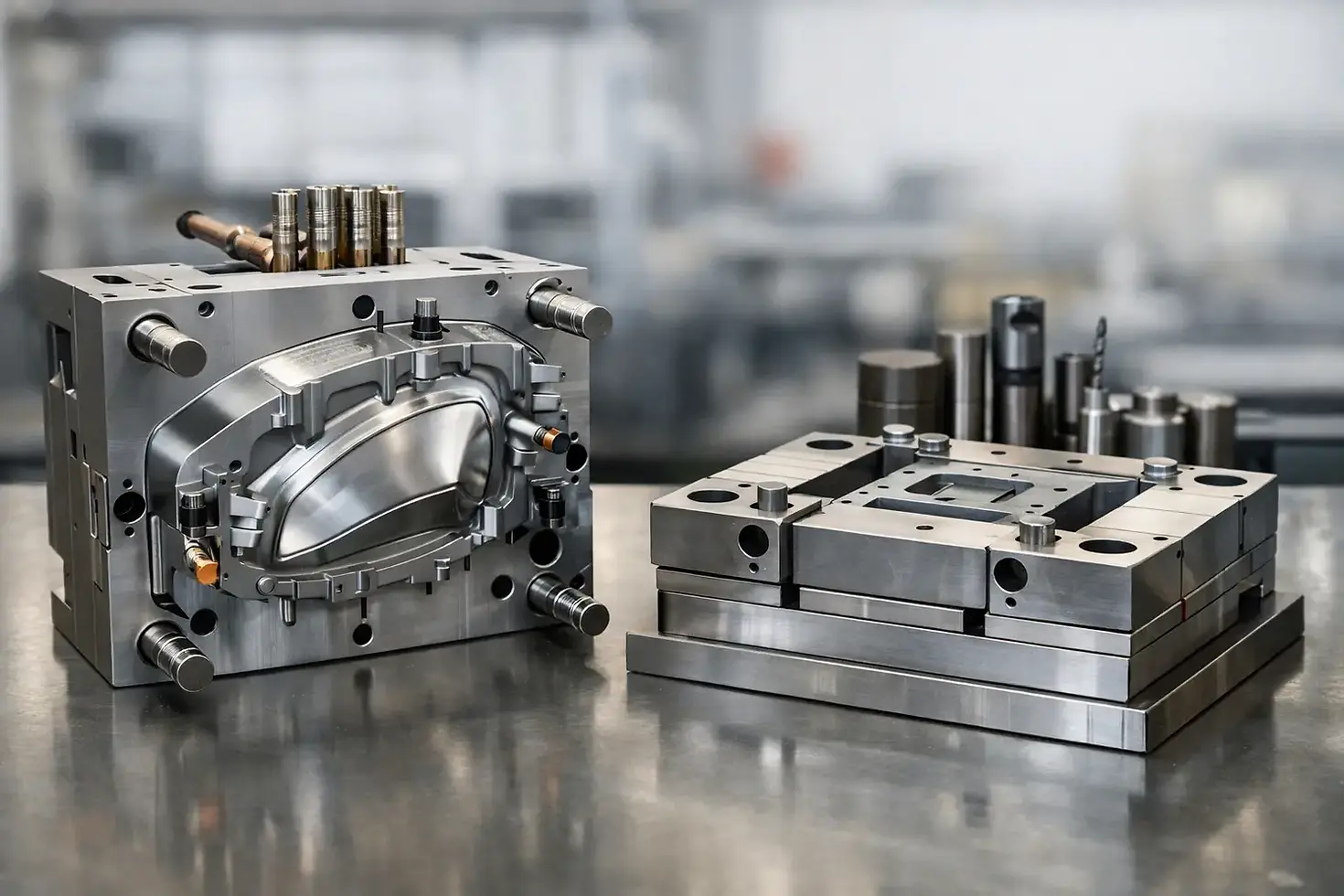
Bespoke Moulds Versus Standard Tooling
When a product sticks in the mould, leaves residue on the line, or comes out with slight shape variation, the issue is rarely just the recipe. In many factories, the real decision sits further upstream - bespoke moulds versus standard tooling. That choice affects output, labour time, waste levels, cleaning demands, and how confidently a product can be scaled.
For commercial food producers, this is not a design preference. It is an operational decision with direct impact on margin and reliability. Standard tooling can be the right answer in some circumstances, particularly when speed and low upfront cost matter most. But where line performance, repeatability, demoulding and product differentiation are under pressure, bespoke tooling usually moves from a nice-to-have to a production requirement.
What bespoke moulds versus standard tooling really means
Standard tooling is built to serve a broad market. It comes in fixed sizes, fixed cavity layouts and limited shape options. That can work well for straightforward products with predictable production needs, especially where the process has already been built around the tool rather than the tool around the process.
Bespoke moulds are designed around the product, the line and the production objective. That means cavity geometry, mould depth, tray size, release characteristics and material choice are all considered as part of one system. In food manufacturing, those details matter because small inefficiencies repeat at scale. A few extra seconds in demoulding, a small rise in product damage, or inconsistent fill across cavities soon becomes a meaningful cost.
The practical difference is simple. Standard tooling asks your process to adapt. Bespoke tooling is engineered to support the process you actually need.
Where standard tooling makes sense
There is no value in pretending standard tooling is always the wrong choice. It can be commercially sensible when a producer is trialling a concept, running short volumes, or manufacturing a product that fits common dimensions and does not present release issues. If the line is flexible and the product is not highly sensitive to shape accuracy, standard options may offer a fast route to market.
Procurement teams often favour standard tools for one obvious reason: lower initial cost. Lead times can also be shorter because the tooling already exists. For some launches, that matters more than refinement.
The trade-off is that the savings are usually visible only at the point of purchase. Once the tool enters production, the limitations start to show. If operators need to handle products more carefully, if cleaning takes longer, or if misshapen units increase reject rates, the lower upfront price can quickly lose its appeal.
Why bespoke moulds are often the stronger commercial choice
In high-volume or quality-sensitive food production, a mould is not just a form. It is part of the production system. Bespoke moulds are developed to improve how that system performs under real operating conditions.
One of the clearest gains is consistency. Custom cavity design helps control product shape, weight distribution and finish. For bakeries, that may mean cleaner definition and more even bake performance. For confectionery, it may mean sharper detail and fewer release defects. For ready meals or plant-based products, it can support cleaner portion control and better visual uniformity.
Demoulding is another major factor. Poor release slows lines, increases manual intervention and damages product. Food-safe silicone, when properly specified and engineered, offers strong non-stick performance without relying on PFAS-based coatings. That reduces sticking, helps preserve detail, and cuts the handling that often leads to waste.
Then there is fit. Bespoke moulds can be designed around existing racks, depositors, ovens, chillers or conveying systems. That matters because line disruption is expensive. A tool that works with the current workflow is usually far more valuable than a nominally cheaper option that creates bottlenecks.
Cost is more than the purchase price
The usual objection to custom tooling is budget. That is understandable, but it is often based on an incomplete view of cost.
A standard tool may cost less to buy, yet cost more to run. Extra labour in filling or release, higher product loss, more frequent replacement, and longer cleaning cycles all affect the true cost per unit. These costs are rarely dramatic in isolation. They accumulate quietly across shifts, batches and product lines.
Bespoke moulds require more investment at the start because there is design work, prototyping and manufacturing involved. The return comes from performance over time. Better release can reduce waste. More accurate cavity design can improve yield. Durable food-safe silicone can extend service life. A tool designed for easy cleaning can reduce downtime between runs.
For production managers and business owners, the better question is not which option is cheaper to buy. It is which option protects margin over the life of the product.
Compliance, hygiene and material choice
This is where a generic tool can become a liability. Commercial food production demands more than basic functionality. Materials must be suitable for food contact, durable under repeated use, and compatible with the temperatures and cleaning regimes used in the process.
Silicone has become a strong choice for modern food manufacturing because it combines flexibility, temperature resistance, durability and hygienic performance. It is also PFAS-free, which matters as regulatory and customer scrutiny around food-contact materials continues to increase.
With bespoke manufacture, material selection is part of the engineering conversation rather than an afterthought. The mould can be specified for the actual production environment - whether that involves blast chilling, baking, freezing or repeated washing. That helps avoid the common problem of buying a standard product that is technically usable but poorly matched to the realities of the line.
Bespoke moulds versus standard tooling in product development
R&D teams often sit at the centre of this decision because they are expected to launch products that are both distinctive and commercially viable. Standard tooling can restrict what is possible. If the cavity shape, depth or configuration is fixed, the product concept may need to be compromised before it even reaches scale-up.
Bespoke tooling changes that conversation. It allows product design and manufacturing design to develop together. Instead of asking whether the product can fit the tool, teams can ask what tool geometry will deliver the desired result consistently.
That is particularly useful in premium bakery, chocolates, filled products and branded shapes where appearance matters as much as throughput. It also helps in functional products where precise portioning, structure or surface detail supports quality control.
The right custom mould does not just create a shape. It makes a product repeatable.
When bespoke is essential rather than optional
Some production environments can absorb compromise. Others cannot. Bespoke moulds tend to become essential when any of the following are true: the product is difficult to release, visual consistency is commercially important, line speed is constrained by tooling, cleaning time is excessive, waste levels are rising, or the product must integrate with existing equipment dimensions.
They are also often necessary where confidentiality matters. If a product design is commercially sensitive, working with an in-house manufacturing partner under NDA protection gives far more control than relying on generic off-the-shelf options and fragmented suppliers.
For many producers, the turning point comes when demand grows. A tool that was acceptable during early production can start limiting output once volumes increase. At that point, custom engineering is not about refinement. It is about removing a barrier to scale.
Choosing on evidence, not assumption
The best decisions here are made on production data. If a standard tool is delivering strong release, acceptable waste levels, reliable hygiene performance and no workflow issues, there may be no reason to replace it. But if teams are compensating for tooling weaknesses with labour, slower cycle times or quality checks, the tool is already costing more than it appears.
A dependable manufacturing partner should be willing to look at the whole picture - product behaviour, line constraints, cleaning requirements, compliance needs and commercial targets. That is where custom silicone mould design delivers the most value. It is not about making something different for the sake of it. It is about engineering a mould that performs properly in a real production environment.
At TCI Culinary, that approach is built around in-house design and manufacture, workflow understanding and long-term accountability. For food producers under pressure to improve consistency, reduce waste and scale with confidence, bespoke tooling is often the more disciplined commercial decision.
If you are weighing bespoke moulds versus standard tooling, start with the pain points on the line rather than the catalogue price. The right mould should not ask your team to work around it. It should make production easier, cleaner and more predictable from the first run onwards.


Comments