
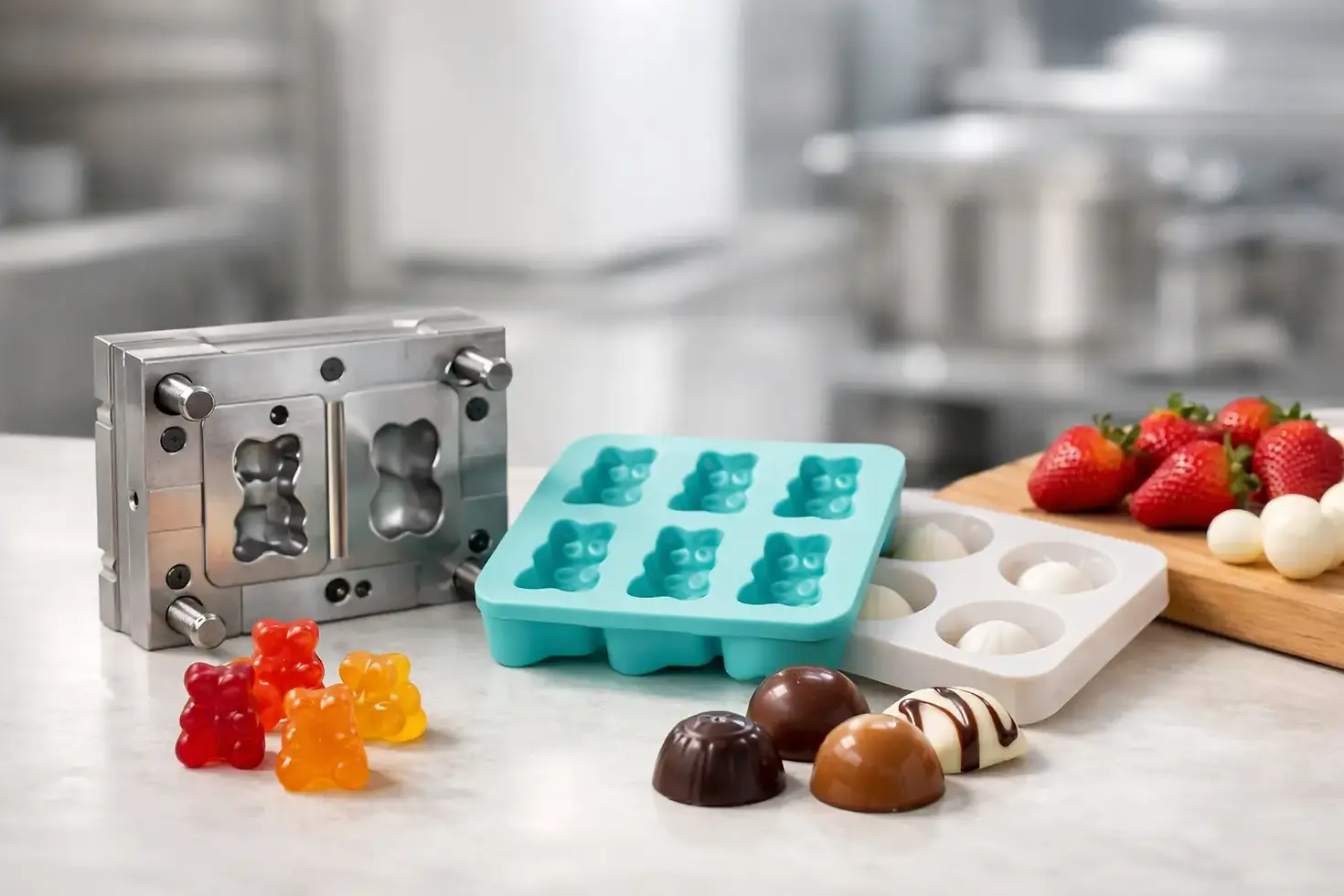
What Makes a Mould Food Safe?
A mould can look clean, release well and survive repeated use, yet still fall short where it matters most. For commercial food producers, the question of what makes a mould food safe is not just about the raw material. It is about the full system around that mould - material selection, manufacturing controls, surface condition, traceability, cleaning performance and suitability for the product and process.
That distinction matters on a live production floor. A mould used for chocolates, bakery items, dairy portions or prepared foods has direct contact with product at critical stages. If the mould is poorly specified, made from inconsistent materials or designed without hygiene in mind, the cost is felt quickly through contamination risk, damaged product, slower changeovers, excess waste and avoidable scrutiny from customers or auditors.
What makes a mould food safe in practice
At a basic level, a food-safe mould is one that is made from materials suitable for food contact and manufactured in a way that does not introduce unacceptable risk. In practice, that means more than claiming a mould is "safe" because it is silicone or because it performs well at temperature.
A food-safe mould must be produced from compliant materials, with a formulation appropriate for food contact. It must resist breakdown during normal use, avoid transferring harmful substances into food, and be capable of being cleaned effectively between runs. Just as importantly, it should be designed for the realities of production, because a technically compliant mould can still become a hygiene problem if it traps residue, tears easily or deforms under pressure.
For manufacturers, the real test is whether the mould supports consistent, auditable and hygienic production over time. That is where material science and engineering discipline meet.
Material choice is the starting point, not the whole answer
Silicone is often chosen for food production because it offers a strong combination of non-stick release, temperature resistance, flexibility and durability. For many applications, it also provides a PFAS-free route to reliable moulding performance, which is increasingly relevant as manufacturers review material choices against changing expectations from customers and regulators.
But not all silicone is equal. What matters is the grade, the formulation and the quality control behind it. A mould intended for food use should be made from materials specifically suitable for food-contact applications, not simply from a generic elastomer that happens to resemble a food-grade option. Fillers, pigments, curing systems and additives all matter because each can affect compliance and performance.
This is why procurement based on material label alone can be risky. "Food-grade silicone" sounds reassuring, but commercial buyers need to know what sits behind that description. Evidence, consistency and traceability carry more weight than broad claims.
Compliance must be evidenced
A mould is not food safe because a supplier says it is. It needs documented compliance against relevant food-contact standards, backed by a controlled manufacturing process. Depending on the product, market and application, that may involve declarations of compliance, material specifications and migration-related data.
For commercial food producers, paperwork is not an administrative extra. It is part of risk management. If a mould is used in high-volume production, especially for customer-facing brands or regulated supply chains, you need confidence that the material used today will match the material used in future repeat orders. Any uncontrolled variation creates risk for QA teams, operations and procurement alike.
That is one reason in-house manufacturing control matters. Where design, material selection and production are closely managed, there is generally better oversight of consistency, accountability and change control.
Design has a direct impact on food safety
A surprising number of food-safety issues come from design rather than material alone. Deep undercuts, awkward corners, weak wall sections and poorly considered geometries can all make moulds harder to clean, slower to dry and more prone to retaining residue.
In a factory setting, the best mould is not simply the one that forms the right shape. It is the one that supports reliable throughput without creating hidden hygiene burdens. Smooth surfaces, appropriate draft, stable dimensions and thoughtful cavity design all help reduce product retention and improve washdown performance.
This is especially important in sectors with sticky, fat-based or particulate-heavy products. Chocolate, caramel, enriched doughs, protein mixes and filled products behave very differently in contact with a mould. A food-safe result depends on matching the mould design to the product characteristics and the cleaning regime, not treating every application the same.
Surface finish and release performance matter
A mould that releases product cleanly is usually easier to keep hygienic. Less sticking means less manual intervention, fewer damaged units and less residue left in cavities between cycles. That has a direct effect on labour, waste and cleaning time.
However, release should not depend on temporary coatings or workarounds that degrade quickly in production. The safer long-term approach is to achieve release through the right material and the right mould geometry. When release performance is built into the mould system, the process becomes more stable and easier to validate.
Durability is part of food safety
A mould can start life compliant and still become unsuitable if it degrades too quickly. Tears, surface damage, swelling, cracking and dimensional instability can all create hygiene and quality issues. Damaged moulds are harder to clean properly, more likely to trap product, and more likely to produce inconsistent outputs.
This is where commercial use differs sharply from occasional kitchen use. In a production environment, moulds face repeated thermal cycling, demoulding stress, wash chemicals and high handling frequency. Food safety depends on how the mould behaves after hundreds or thousands of cycles, not just on day one.
For that reason, durability should be assessed alongside compliance. A short-life mould may appear cheaper at purchase, but if it increases downtime, inspection burden or replacement frequency, the true cost is much higher.
What makes a mould food safe over time?
Long-term food safety comes down to control. The mould must remain stable in the actual operating environment, and the producer must be able to inspect, clean and replace it within a managed system.
That means having clear cleaning procedures, visual inspection criteria and an understanding of when a mould should be retired. It also means choosing moulds designed for repeated production rather than adapting unsuitable off-the-shelf formats to commercial use. In many operations, the safest option is not the cheapest standard product. It is the mould that fits the line, the product and the hygiene protocol from the outset.
There is also a practical point here for multi-site or scaling manufacturers. Standardising mould performance across batches and sites makes food safety easier to manage. When dimensions, material quality and release behaviour are consistent, SOPs are easier to maintain and deviations are easier to spot.
Manufacturing standards behind the mould
Even a well-designed mould made from the right material can become a risk if manufacturing standards are poor. Contamination during production, inconsistent curing, uncontrolled trimming or weak batch traceability can undermine the finished product.
This is why experienced food producers tend to assess the supplier as carefully as the mould itself. Can the manufacturer demonstrate process control? Is there accountability for repeatability? Are design revisions documented? Is the product made under a system that supports traceability and commercial consistency?
For bespoke projects, these questions matter even more. A custom mould is often built to solve a very specific production issue - poor release, excess giveaway, shape inconsistency, slow cycle time or damage in handling. If the manufacturing partner does not control the process tightly, the mould may solve one problem while introducing another.
At TCI Culinary, that is why custom mould development is approached as an engineering and production partnership rather than a commodity purchase. The aim is not only to deliver a compliant mould, but to deliver one that performs reliably within the customer's real process.
Food safety and production efficiency should work together
One of the common mistakes in mould selection is treating food safety and efficiency as separate issues. In reality, they are closely linked. A mould that cleans quickly, releases consistently, holds its shape and withstands repeated use is usually supporting safer production as well as better output.
There are trade-offs, of course. A more intricate product shape may be valuable commercially, but if it creates cleaning challenges or slows demoulding too much, the design may need refining. A softer mould may aid release in one application, while a firmer construction may deliver better dimensional control in another. The right answer depends on product type, volume, handling method and wash regime.
That is why specification work should happen early. When R&D, operations and procurement align on food-safety requirements and production outcomes together, mould selection becomes more effective and less reactive.
If you are evaluating what makes a mould food safe, the useful question is not whether a material sounds suitable on paper. It is whether the complete mould system will stand up to your product, your process and your standards day after day. That is the level of confidence commercial production needs.


Comments