

Choosing a Bakery Mould Manufacturer for Scale
- thomas lane
- 3 days ago
- 6 min read
A mould that releases cleanly on a trial bench can become a costly bottleneck at production volume. When products stick, deform, bake unevenly or require excessive manual handling, the effects reach far beyond presentation: waste rises, cycle times extend and margins come under pressure. Choosing the right bakery mould manufacturer is therefore a production decision, not simply a purchasing exercise.
For commercial bakeries, the best result is rarely achieved by selecting a standard tray from a catalogue. A well-designed mould system needs to reflect the product, the recipe, the oven profile, the depositor or filling process, the cooling stage and the people working on the line. That is where a specialist manufacturing partner adds measurable value.
What a bakery mould manufacturer should solve
A mould has one basic job: to create a repeatable product shape. In a commercial setting, however, it must do much more. It needs to support consistent portion control, predictable release, hygienic cleaning and reliable handling across hundreds or thousands of cycles.
The challenge is that no two production lines are exactly alike. A high-fat financier mixture behaves differently from a low-sugar cake batter. A dense sourdough portion creates different demands from a delicate filled pastry. Product geometry, deposit weight, bake time and cooling conditions all affect the right mould design.
A capable manufacturer begins with the operational problem. Perhaps a bakery is losing product through breakage at demoulding. Perhaps operators are spending too long preparing, greasing or cleaning conventional tins. Perhaps an R&D team has created a distinctive product shape that cannot be produced consistently using off-the-shelf equipment. The mould should be engineered around that need, rather than asking the production team to work around a generic format.
Why custom silicone moulds change line performance
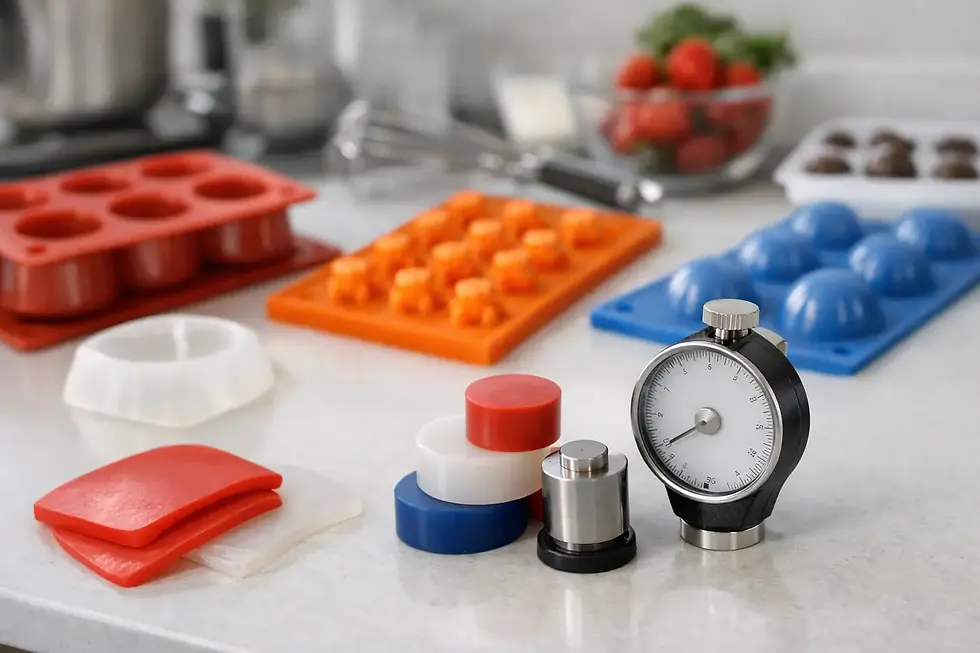
Food-safe silicone is particularly well suited to demanding bakery applications because it combines flexibility with dimensional stability. Its non-stick properties can reduce dependence on release agents, helping products leave the cavity with less damage and less residue. That can improve product appearance while reducing the ingredients, labour and cleaning associated with repeated greasing.
Temperature resistance is another practical advantage. A properly specified silicone mould can move through demanding heat and cold conditions without the corrosion concerns associated with some metal formats. It can also be designed for the required oven, blast chilling or freezing process, provided the material grade and operating parameters are assessed from the outset.
The value is not simply the material itself. Cavity geometry, wall thickness, mould depth, rim design and reinforcement all affect how a mould performs. A shallow, high-output tray may require a different structural approach from a deep cavity mould carrying a heavier deposit. If the mould is too flexible, handling can become awkward. If it is over-engineered, it may add unnecessary weight or cost. The correct design balances release, rigidity, throughput and operator usability.
For some applications, silicone can also support cleaner changeovers. Moulds designed for easy handling and washdown can reduce time lost between batches, especially where product ranges, allergens or frequent recipe changes require disciplined cleaning procedures.
Consistency starts with cavity design
Uniform cavities help control portion size, bake profile and finished-product appearance. This matters for premium retail products as much as high-volume foodservice lines. A slight variation in cavity volume can create uneven baking, inconsistent weights or difficulties with packaging machinery downstream.
Custom tooling makes it possible to define details that standard moulds often overlook: a sharper edge, a particular embossing feature, a controlled base profile or a cavity layout matched to an existing rack, oven band or depositor. These details protect brand presentation, but they also make production more predictable.
Assess the full production workflow, not the mould in isolation
A useful mould design begins with a close look at how it will be used. Procurement price matters, but the lowest unit cost can be misleading if a mould slows the line, fails prematurely or creates avoidable waste.
Before specifying a solution, consider how the mould will enter the process, how it is filled, transferred, baked, cooled, demoulded, cleaned and stored. A mould that performs well manually may need additional support for automated or semi-automated handling. Equally, a layout that maximises cavities on paper may not be the best choice if it makes trays difficult to lift safely or causes uneven oven airflow.
Questions worth resolving early include:
What product weights, dimensions and tolerances must the mould achieve?
Which temperatures, dwell times and cleaning routines will it experience?
Does it need to fit existing trays, racks, depositing equipment or packaging formats?
Is the main priority faster release, a new product shape, higher output or reduced material waste?
What production volumes and replacement expectations will determine whole-life value?
These questions are interdependent. For example, increasing the number of cavities may increase output per tray, but it can also affect rigidity, airflow and handling. A manufacturer with practical bakery experience should explain these trade-offs clearly rather than treating every request as a straightforward replica exercise.
Food safety and traceability are design requirements
Commercial food production demands more than a mould that looks correct. Materials must be suitable for food contact, and the manufacturing process must provide confidence in consistency, cleanliness and traceability. This is particularly relevant where moulds are used repeatedly, exposed to high temperatures or incorporated into audited production environments.
Ask how the manufacturer controls materials, production and quality checks. Food-safe silicone should be selected and processed for the intended application, with clear attention to the relevant food-contact requirements. It is also sensible to understand the expected use conditions, cleaning guidance and any limits that could affect service life.
There is a growing commercial case for considering PFAS-free silicone solutions too. Food producers are under increased scrutiny from retailers, regulators and consumers regarding materials used around food. Selecting a suitable silicone mould can support a more considered compliance position while delivering the practical benefits of non-stick performance.
Confidentiality also matters when a mould incorporates a proprietary shape, branded detail or new product concept. For innovation-led bakeries, NDA-backed development protects the value of work completed before a launch reaches the market.
Look for engineering support before and after manufacture
A dependable bakery mould manufacturer should be prepared to challenge an early concept where necessary. A product developer may have a clear visual brief, while the production team needs a shape that releases reliably and can be handled at pace. Both requirements are valid. The manufacturer’s role is to turn them into a workable mould system.
This often involves reviewing CAD concepts, test samples and prototype performance before moving into full production. It can also mean recommending a change in cavity angle, strengthening a mould perimeter or adjusting the layout to suit equipment already installed on site. These interventions can prevent expensive revisions later.
In-house design and manufacturing provide greater control over this process. They shorten communication loops, make technical changes easier to manage and create clearer accountability if a problem needs investigation. For businesses making a long-term investment in production capability, warranty protection and a dedicated account contact add further reassurance.
TCI Culinary approaches custom moulding as part of the production system, combining food-safe material expertise with practical engineering support from concept through to implementation. The objective is not to sell more moulds than necessary, but to build a solution that remains dependable through daily use.
Calculate value over the mould’s working life
The right comparison is not mould price versus mould price. It is the total cost of achieving a saleable product, consistently, over time. A custom mould may carry a higher initial investment than a standard alternative, yet deliver a stronger return if it reduces breakages, minimises release-agent use, cuts cleaning effort or improves output per shift.
Consider the cost of a single recurring defect. If poor release damages even a small percentage of products, the loss includes ingredients, energy, labour, disposal and missed saleable output. If the issue also creates inconsistent appearance, it may lead to rework or rejected packs. A mould that addresses the root cause can protect margin every day it is in service.
Durability should be assessed in the same way. Reusable silicone moulds are intended to support repeated production, but their working life depends on correct specification, handling and cleaning. The right supplier will be realistic about those conditions and provide guidance that helps protect the investment.
A productive first conversation with a mould manufacturer starts with real line data: product dimensions, target output, existing equipment, process temperatures and the specific losses or delays that need to be removed. Bring those details to the table, and the mould becomes more than a shaped cavity - it becomes a practical tool for making every batch easier to produce well.

Comments