Guide · chocolate
Silicone or polycarbonate chocolate moulds?
Both make excellent chocolate. They suit different jobs. Here's an honest comparison to help you choose.
The short answer
Which one should you choose?
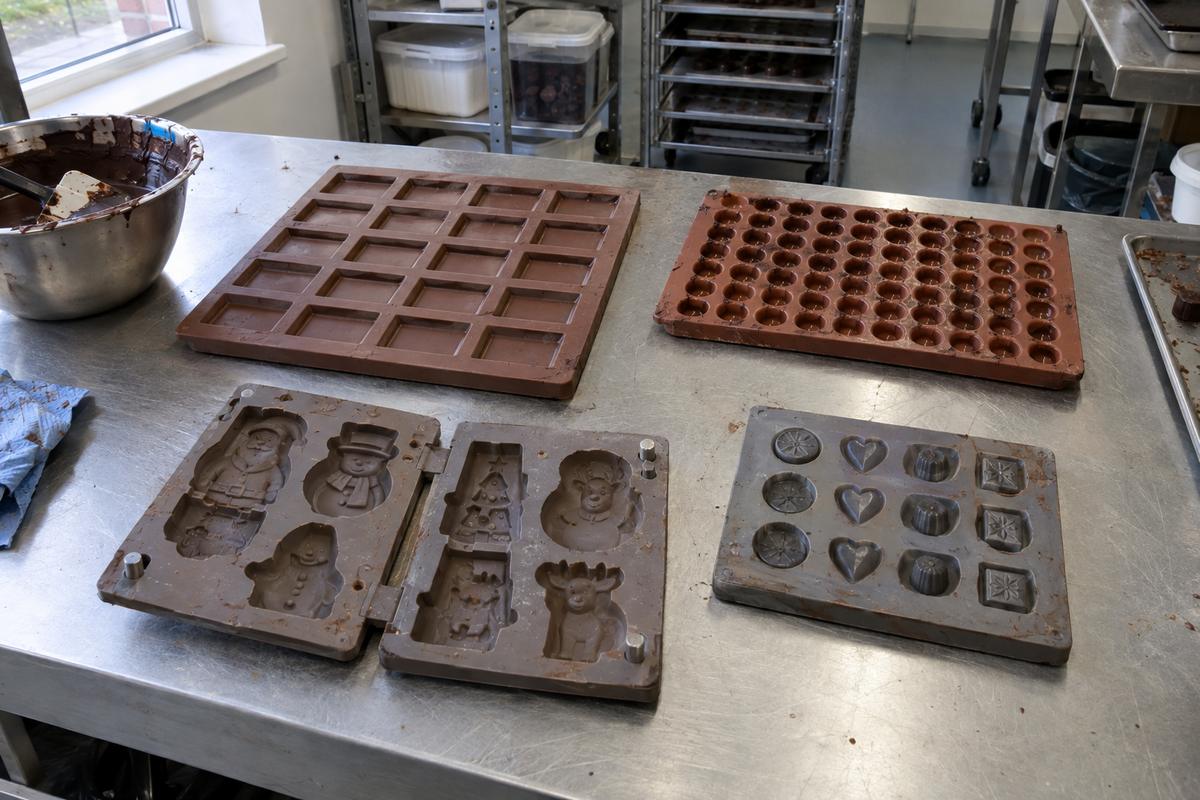
Polycarbonate is rigid and highly polished. Properly tempered chocolate contracts away from it and comes out with a hard, glossy shine. It is the standard for bonbons and bars on professional and industrial lines, but each new shape needs its own tool, which makes it costly for short runs or new designs.
Silicone is flexible, so it releases undercuts and complex 3D shapes that a rigid mould cannot. A custom silicone mould is far quicker and cheaper to make from a new design. It gives a satin to glossy finish depending on the cavity surface, rather than the mirror shine of polycarbonate.
Diagram
Why they release differently
Why they release differently
Swipe to see the whole diagram
Comparison
Side by side.
| Silicone | Polycarbonate | |
|---|---|---|
| Finish | Satin to glossy, depending on the cavity surface and tempering | Very high gloss when chocolate is well tempered |
| Shapes | Undercuts, deep relief and full 3D shapes | Shapes that release straight out, with draft |
| New designs | Quick and economical to make from a 3D file or sample | Each shape needs a machined tool, so new designs cost more |
| Run length | Short runs, seasonal ranges, launches and bespoke work | Long runs of a fixed range |
| Line use | Hand work, small enrobing and shell lines; check with automated plants | Standard on automated one-shot and shell lines |
| Handling | Flexible; may need a rigid tray underneath | Rigid, stacks and stores easily |
| Cleaning | Warm water and mild detergent; avoid abrasives | Warm water, soft cloth; avoid abrasives and harsh detergents |
Silicone
When silicone is the better choice.
- You are launching a new or seasonal shape and don't want the tooling cost of a rigid mould.
- The design has undercuts or deep relief: figures, animals, textures or hollow 3D pieces.
- You need a logo or brand shape made quickly from your own artwork.
- You are making small batches by hand, or testing a product before committing to production tooling.
Polycarbonate
When polycarbonate is the better choice.
- You need the highest gloss on classic bonbons, pralines or bars.
- You run an automated shell or one-shot line designed around rigid moulds.
- The range is fixed and long-running, so the tooling cost spreads across a large volume.
Finish
Getting a better shine from silicone.
- Temper well. Shine comes from good crystal structure as much as from the mould.
- Polished masters. A silicone cavity copies its master, so a smooth master gives a smoother chocolate surface. Our guide to chocolate mould finish and gloss goes into more detail.
- Keep cavities clean and dry. Fat and water residues dull the surface. Avoid abrasive cloths.
- Cool steadily. Very fast chilling can cause bloom or marks on the surface.
Questions
What buyers ask us.
Do silicone chocolate moulds give a shiny finish?
They can give a good satin to glossy finish, particularly with a polished master and well-tempered chocolate. For the very highest mirror gloss, polycarbonate is still the benchmark.
Can you make a custom chocolate mould from our logo?
Yes. Send a vector file or 3D model and we'll make the master and the silicone mould, and check the detail reads at the finished size.
Are your chocolate moulds food grade?
We use platinum-cure food-grade silicone and can supply the declaration of compliance and material test reports for the grade.
Do you make polycarbonate moulds?
Not in-house. If polycarbonate is the right choice we'll say so and can help arrange it through our sourcing service.
Next step
Have a chocolate shape in mind?
Send the artwork or a sample. We'll tell you whether silicone suits it before you spend anything.
Real people, a real workshop
You deal with the people who make it.
No call centre and no middlemen. When you contact TCI Culinary, you speak to the team who design, build and check your mould.
- A real Warwickshire workshopUnit 15, Waterloo Park, Bidford-on-Avon, Alcester B50 4JG.
- Real people on the phoneCall the team on 01789 224228, Monday to Friday.
- The same team on every jobDesign, production and aftercare come from the people you see here.
- BRCGS Grade AATechcraft Industries Culinary Ltd. See the certificate details.



 Thomas LaneManaging Director
 George PrestonDesign & Project Manager
 Kelly BallingerHead of Partnerships
 Jim AndertonProduction Manager
 TheodoreEmployee Welfare