The product
What you are making, its weight or volume, and a photo or drawing of the shape.
Guide · food manufacturing
What to specify, what to ask for and what to watch out for when you buy silicone moulds for a production line, not a kitchen.
Start here
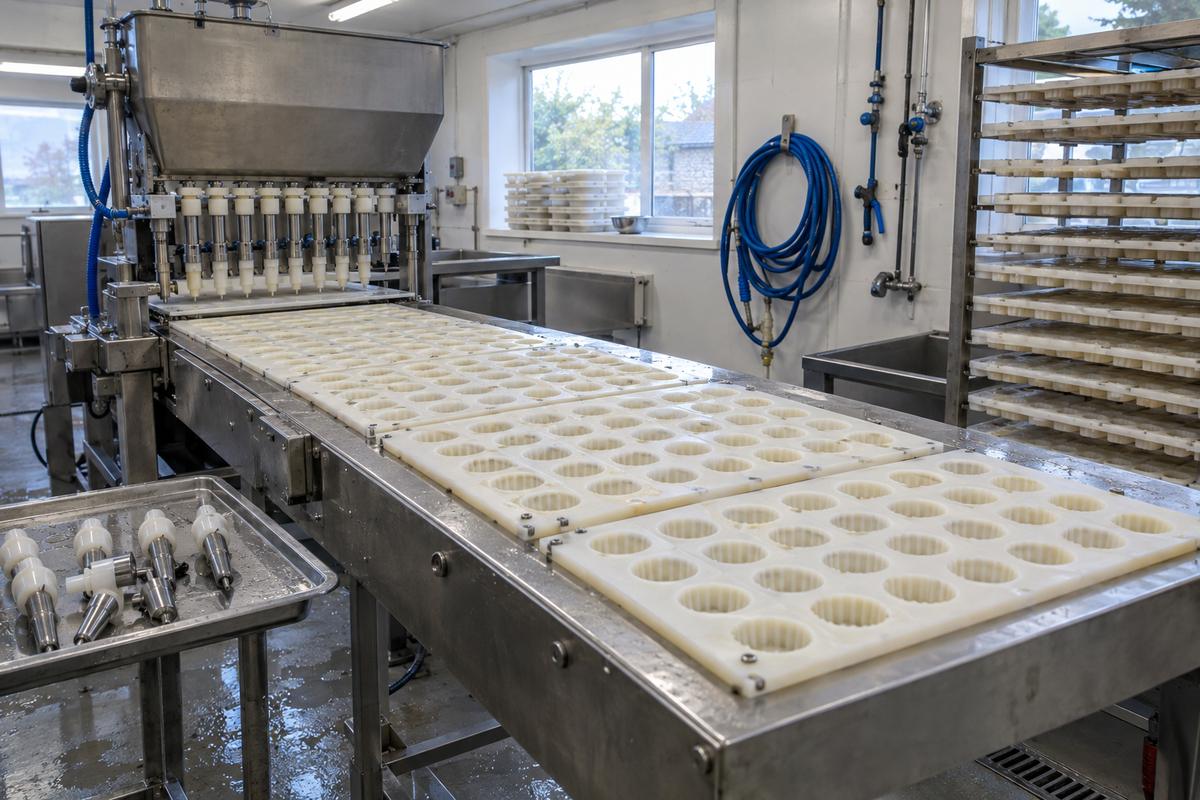
A retail silicone mould is designed to be bought, used and replaced. An industrial food mould is designed around a process: a depositor, an oven, a blast chiller, a wash cycle and an auditor. It has to fit your equipment to the millimetre, survive hundreds of cycles without changing shape, and arrive with documents that show the material is suitable for food contact.
That changes the questions you should ask. Cavity shape matters, but so do tray footprint, stiffness, the grade of silicone, how it is cleaned, and what happens when a tray is worn out and needs replacing with an identical one.
Material
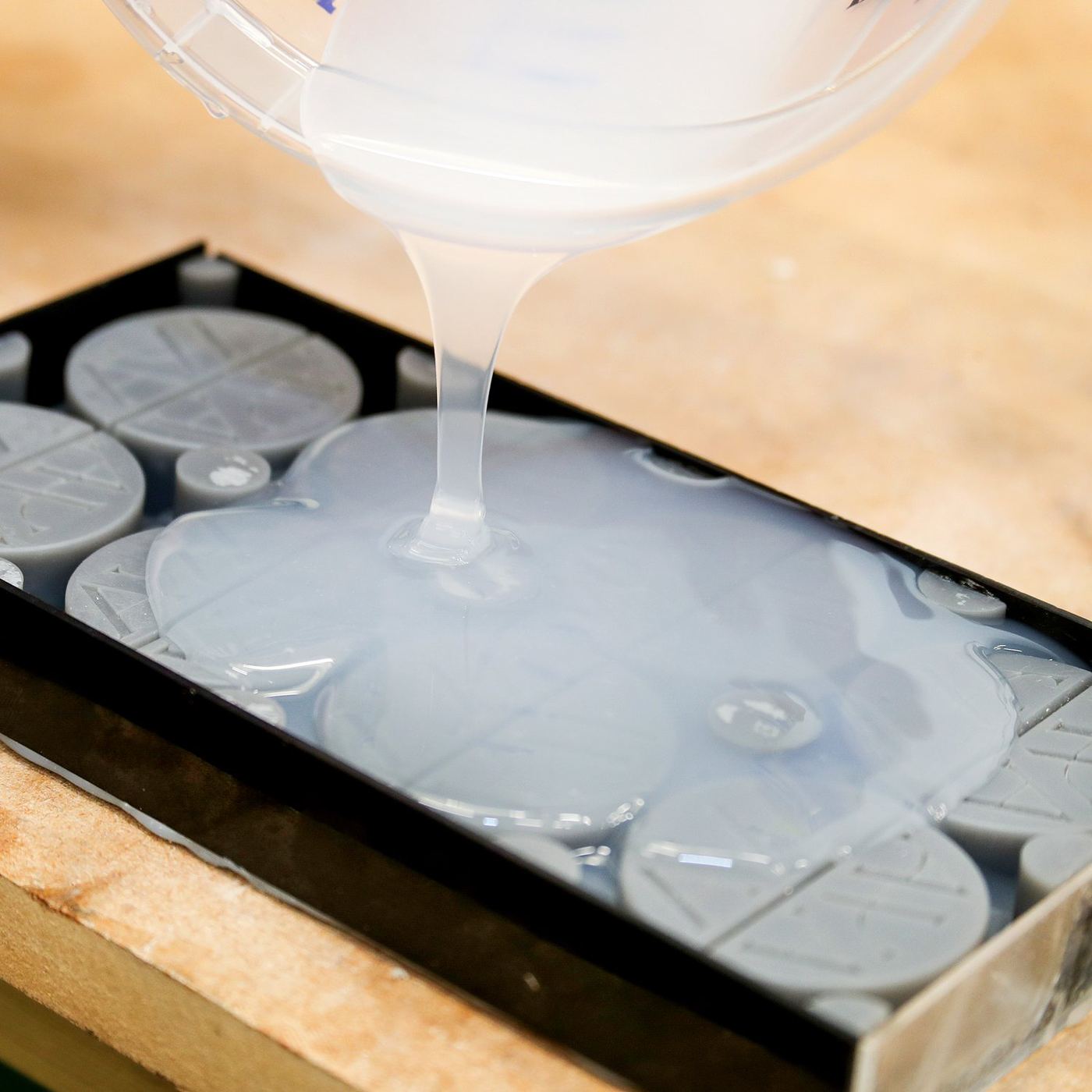
Most food moulds are made from platinum-cure (addition-cure) silicone. It cures without by-products that need driving off, holds its dimensions well and is the usual choice for food-contact work. Tin-cure (condensation) silicones are cheaper and common in craft moulds, but they shrink slightly as they cure and are not normally used for food.
Within platinum grades, the choice comes down to three things:
Compliance
In the UK, food-contact materials fall under the framework regulation (EC) No 1935/2004, as retained in UK law, and good manufacturing practice rules under (EC) No 2023/2006. Silicone has no specific UK or EU measure of its own, so suppliers usually show suitability by testing against recognised references, most often the German BfR Recommendation XV for silicones and the US FDA rule 21 CFR 177.2600 for rubber articles intended for repeated use.
In practice, a buyer or auditor will usually want:
Diagram
Parts of a production cavity
Swipe to see the whole diagram
Equipment
The most common reason an industrial mould fails is not the silicone. It is a tray that is a few millimetres too big for the depositor plate, a cavity pitch that does not match the nozzles, or a tray that sags on the conveyor. So we design from the equipment inwards:
| Check | Why it matters | What to send |
|---|---|---|
| Tray footprint | Must sit in your depositor plate, oven rack or chiller shelf with the clearance your line expects. | Plate or shelf drawing, or measured internal size |
| Cavity pitch | Cavity centres must line up with depositor nozzles, or product lands off-centre. | Nozzle count and centre-to-centre spacing |
| Location | Edges, corners or pins locate the tray so it sits in the same place every cycle. | Photo of the plate or guide rails |
| Stiffness | Trays carried on a conveyor or stacked in racks need to stay flat when full. | How the tray is moved and supported |
| Temperature | Hot deposits, baking or blast freezing affect grade choice and wall thickness. | Deposit temperature and the full cycle |
Design
Care
Platinum silicone tolerates normal food-factory cleaning, but strong alkaline or chlorinated chemicals, abrasive pads and very hot washes all shorten its life. Ask your chemical supplier to confirm compatibility with silicone, and tell us your wash regime so we can choose a grade to suit.
Lifespan depends on the product, the temperature, how the trays are handled and how they are cleaned, so we won't promise a cycle count without knowing your process. What we can do is keep the master and the specification on file, so a worn tray can be replaced with an identical one rather than a near match.
Brief
What you are making, its weight or volume, and a photo or drawing of the shape.
Depositor, plate, oven or shelf sizes, and the nozzle pitch if you deposit.
Deposit and set temperatures, bake or freeze steps, and how trays are cleaned.
What your customer or auditor needs to see, so we quote the right documents.
How many trays now, how many cycles a day, and how you expect that to grow.
When you need samples and when the line needs the trays. We'll tell you honestly what is realistic.
Questions
Yes, when the grade, design and paperwork suit the process. Platinum-cure silicone is widely used for depositing, baking, setting and freezing. We confirm the conditions the material is tested for, and help you check the rest.
Normally a declaration of compliance for the finished mould, the material supplier's test reports for the grade, and the conditions of use they cover. Tell us what your auditor needs and we'll confirm before you order.
Yes. Send the plate size and the nozzle count and pitch, and we'll design the cavity layout to line up with them. We usually recommend a proof cavity or single tray before a full set.
Yes. We keep the master and the specification on file so replacement trays match the approved original.
We make silicone moulds. If metal or polycarbonate is genuinely the better answer for your line, we'll say so and can help arrange it through our sourcing service.
Next step
Send the product, the equipment and the process. We'll come back with honest questions and a design to approve.
Real people, a real workshop
No call centre and no middlemen. When you contact TCI Culinary, you speak to the team who design, build and check your mould.



 Thomas LaneManaging Director
 George PrestonDesign & Project Manager
 Kelly BallingerHead of Partnerships
 Jim AndertonProduction Manager
 TheodoreEmployee Welfare