Measure
You send the plate size, nozzle pitch, deposit weight and a sample or drawing.
Confectionery · starchless depositing
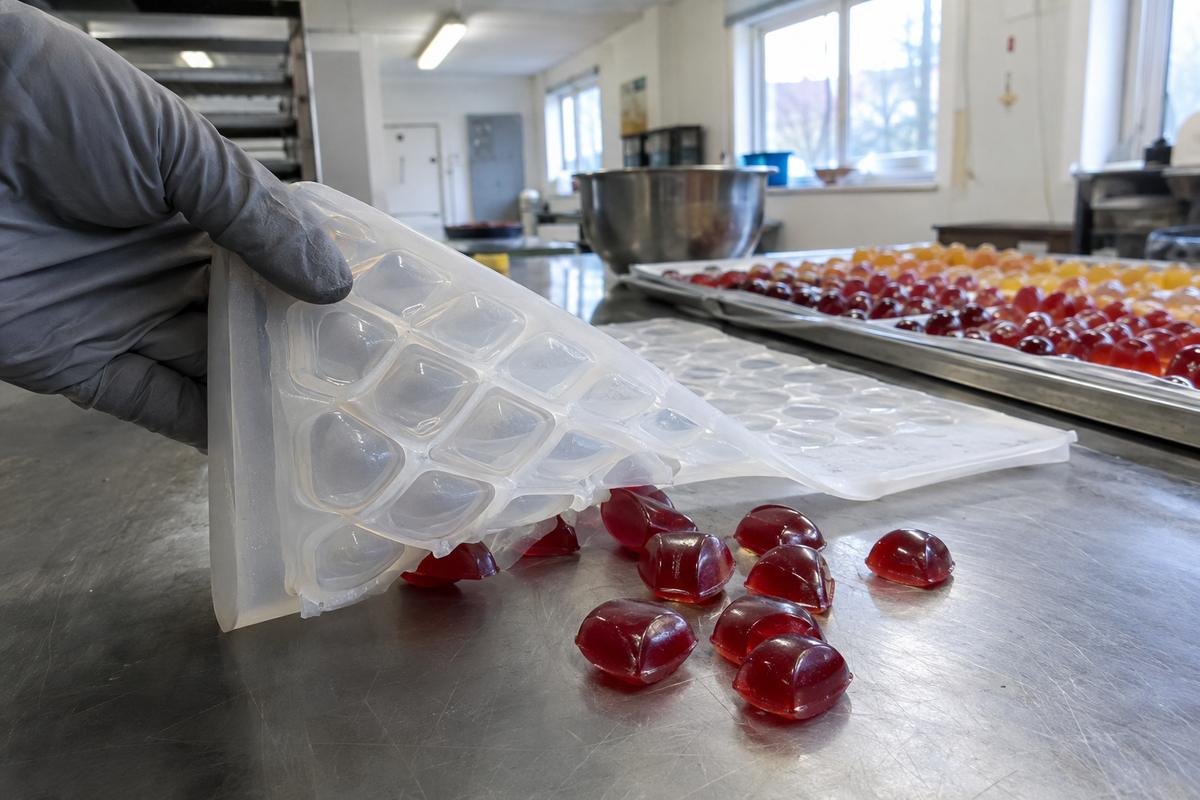
Silicone trays that sit under your depositor and line up with every nozzle, so you can make gummies without a starch mogul.
The basics
Traditional gummies are deposited into impressions pressed into trays of dry starch on a starch mogul. The starch shapes the gummy and draws out moisture, but it needs a large machine, dust control and a lot of handling.
In starchless depositing, the syrup goes straight into a permanent mould. Large lines often use rigid metal moulds with a non-stick coating and mechanical ejection. For pilot lines, short runs, product development and many supplement and vitamin gummies, flexible silicone trays are a practical alternative: no starch, quick changeovers and easy release by flexing the tray.
Diagram
How a tray lines up with your depositor
Swipe to see the whole diagram
Specification
| Detail | Why we need it |
|---|---|
| Plate or tray size | The tray must drop into your plate or conveyor with the right clearance. |
| Nozzle count and pitch | Cavity centres are set to the nozzle spacing so every deposit lands centrally. |
| Row spacing or index distance | Sets the distance between cavity rows as the tray moves under the head. |
| Deposit weight and shape | Sets the cavity volume and depth. Send a sample or drawing if you have one. |
| Deposit temperature | Hot syrups affect the grade and wall thickness we choose. |
| Setting and demoulding | Ambient, chilled or stoved; by hand or by machine. This sets the hardness. |
Recipes
Silicone trays suit pectin, gelatine and starch-free vegan recipes. What changes is the release and the cleaning. High-sugar pectin sets fast and releases cleanly. Gelatine can stick more at warm temperatures, so the set needs to be chilled. Vitamin and supplement gummies often contain acids, oils or actives, so tell us what is in the recipe and we'll confirm the grade suits it.
Some producers use a light release agent or a sugar or acid sanding after demoulding. If you do, tell us, because it affects the surface finish we give the cavity.
How we work
You send the plate size, nozzle pitch, deposit weight and a sample or drawing.
We draw the cavity layout over your plate and send it for approval.
A single proof tray or cavity block, so you can run it on your own depositor.
We fine-tune the volume, depth or release from your trial results.
The full set of trays, identical to the approved proof.
We keep the master and specification on file for matching replacements.
Questions
Yes. Flexible silicone trays are used for starchless depositing on pilot lines, short runs, product development and many supplement gummies. Very high-speed lines often use rigid coated metal moulds instead; we'll tell you which suits your output.
No. We make the silicone moulds, designed around the depositor you already have or are buying.
The plate or tray size, nozzle count and pitch, row spacing, deposit weight and temperature, and a sample or drawing of the gummy.
Yes, from a vector file or a sample. We'll check the detail is deep and wide enough to read at gummy size.
By flexing the tray, by hand or with a demoulding aid. Release depends on the recipe and how well it has set, which is why we recommend a proof tray first.
Next step
With the plate size, nozzle layout and a sample, we can draw your tray layout for approval.
Real people, a real workshop
No call centre and no middlemen. When you contact TCI Culinary, you speak to the team who design, build and check your mould.



 Thomas LaneManaging Director
 George PrestonDesign & Project Manager
 Kelly BallingerHead of Partnerships
 Jim AndertonProduction Manager
 TheodoreEmployee Welfare